


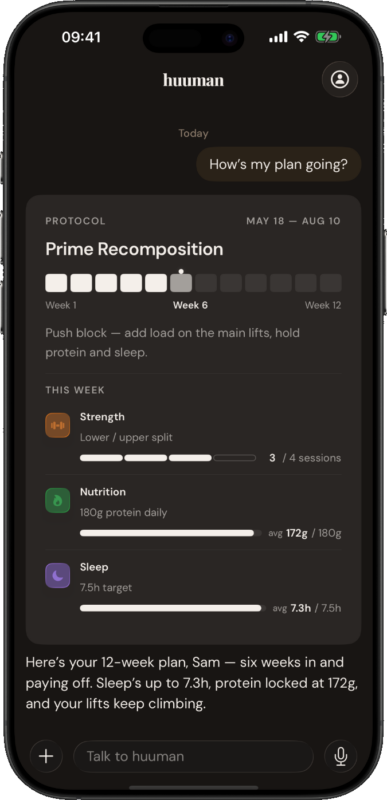
- Somewhere between your Apple Watch, your blood work, your sleep tracker, and your gym app, a clear picture of your health should exist. It doesn’t. You have more data about your body than any generation in history, and almost no way to make sense of it all. huuman changes that. huuman is a health and longevity platform built on one principle: the best health decisions come from understanding your own body. Not from trends, not from influencers, not from one-size-fits-all protocols. At huuman we’re building a system that brings together the five core areas of human health (Heart, Frame, Metabolism, Recovery, and Mind) into one clear, actionable picture. Backed by science. Personalized to you. Source: huuman.life
Listening to your body and monitoring your coaching app, let’s see what that looks like.
The Thing About Stairs
Here’s the thing about stairs and walking and hiking trails as we age. It’s rarely the climb that gets us, right? Going up, we’re slow and a bit sweaty, but going down is where the knees start to grumble and the railing or walking sticks suddenly seem like a very good idea. There’s a perfectly good reason for that, and it has more to do with physics more than with birthdays. Better yet, it’s something we can actually work on at home. While going up, the big muscles on the front of your thighs do the pushing. While going down, the same muscles act like brakes, lengthening as they hold you back one step at a time. And, as it turns out the brakes have the tougher job.
One study of 84 healthy people between ages 60 and 88 measured how hard the knee works on a staircase. On the way up, those thigh muscles were giving just about everything they had. The way down took more than that, roughly 120% of it, which leaves very little in reserve for a wet step or a loose rock. * See study details at huuman.life
The Way Down
Statistically, stair falls account for more than 10% of fatal falls, and the way down is the riskier direction. Or, just ask your knees. In a group of more than 4,000 people who had, or were at risk of knee arthritis, the stairs were the first place knee pain showed up, before walking, standing, sitting, or lying in bed.
Line up healthy people between 65 and 89, as one study did, and the gap from youngest to oldest works out to about 1 to 2% of strength per year, and closer to 3.5% of power, the quick kind of strength that gets you up out of a low chair and onto a high step. That gap showed up more clearly in the men than in the women. * See study details at huuman.life
Take the Elevator Up
The fix is to practice the way down with purpose. In one small study, women 60 and over who were carrying quite a bit of extra weight spent 12 weeks walking down stairs, twice a week, and only down. They rode the elevator up. Yes, really! Their knee strength went up 34%, compared with 15% for a group that walked up the stairs instead, and their heart rate during the sessions was on the whole, lower. * See study details at huuman.life
It works at age 80, too. In a small study of elderly people, who spent 11 weeks practicing braking on an exercise machine, found the practice made them 60% stronger and 21% better at getting down stairs. And, it moved them from a high fall risk to low risk. The folks in the study actually called it relatively effortless. Add up seven studies on step training (practicing quick, deliberate steps) the number of falls dropped by roughly 50%. Seemingly, the credit went to better reaction time and balance rather than strength. * See study details at huuman.life

Ten Minutes at the Kitchen Counter
None of the above needs a gym, just a sturdy chair, the bottom stair, and the kitchen counter to hold on to. Three times a week, about 10 minutes total.
Sit-to-stands. Sit in a sturdy chair, arms crossed, then stand up. Then sit back down slowly, counting three seconds on the way down. The slow part is what counts. Ten times, two rounds. When that gets a bit too easy, try a lower chair.
Step-downs. Stand on the bottom stair, one hand on the railing. Lower one foot toward the floor, slowly, counting three seconds. Tap your heel, then press back up. Do this eight to 10 times on each leg. When it gets easy, lighten your grip on the railing, then let go, then start from the second stair.
One-leg stands and side steps. Stand on one foot while the coffee brews… 10 seconds on each side, and work toward 30. It doubles as a test. (Of 1,702 people between age 51 and 75, one in five couldn’t hold it for 10 seconds. Those who couldn’t hold it for 10 seconds fared worse over the following years.) Next take a few quick steps sideways along the counter, and a few back. There’s your step training. A little kitchen dance, so-to-speak. * See study details at huuman.life
How Much is Enough?
How much is enough? The programs that prevented falls the most were the ones that challenged your balance and ran more than three hours a week. So, 10 minutes is where we start, but the more the better. If you want more than three hours per week, the strength, muscle and mobility overview on the huuman blog offers plenty more.
Your Body & Your Coaching App
Listen to your body. If your knees have started complaining on the stairs before anywhere else, that’s the early warning sign mentioned here, and it’s worth a quick chat with your doctor before you spring for a new pair of boots.
Walking sticks do help, by the way. In one small study, poles took 12 to 25% of the load off the knee on a steep downhill. A railing can share some of that work. And, if you’d rather have someone tell you when it’s time for the lower chair or the second stair, a physical therapist can do that in person. So can a coaching app like huuman that builds the leg strength a park day calls for. One size does not fit all, knees included.
Your Body & Your Coaching App Quick Tips
- Walking sticks (or the railing) for the steep parts on hiking trails
- Sit-to-stand, 2 rounds of ten, 3 times a week
- Step-down from the bottom stair, 8 to ten per leg
- One-leg stand, 10 to 30 seconds per side, plus a few quick side steps
- Stay hydrated and well-nourished
Photo credit: huuman.life



 Instagram Feed



Leave a Comment